Visual Arts Center
July 20th, 2008 |
Published in
all news, Hanover/Leb./Nor'ch., History, preservation, Visual Arts Center
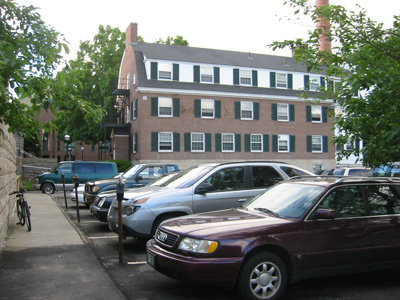
The former automobile dealership of Clement Hall, whose main block was built in 1914 using mill construction, will be demolished within days. The Dartmouth. Many governments require landowners seeking permission to demolish historic buildings to mitigate the effects of the destruction of history at least somewhat by documenting the building to HABS standards. While Dartmouth has announced its voluntary compliance with regulations designed to protect the natural environment, it seems to lag behind others, including state schools, when it comes to the cultural environment. One hopes that a basic set of large-format black and white photographs, at least, will survive after Clement Hall is torn down.
July 19th, 2008 |
Published in
all news, Hanover/Leb./Nor'ch., publications, Visual Arts Center
The article in The Dartmouth has a depiction of the Visual Arts Center from another angle:
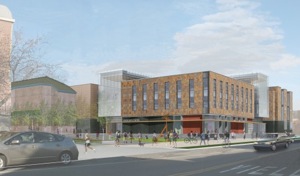
image from The Dartmouth
The story in the Valley News, in which one person on a College committee of town advisors calls the building “hideous,” has been picked up by the Nashua Telegraph, the Boston Globe, Burlington’s WPTZ tv, the [Laconia?] Foster’s Daily Democrat, and others.
It is unfortunate that the materials presented to the committee are not available on line, and that readers have only the two images from which to judge the design. It is also unfortunate that some of the committee members quoted failed to give thoughtful reasons to object to the design. Dartmouth will probably ask for more than unsubstantiated, unsophisticated gut reactions before it considers redesigning this building.
For example, calling the design too “urban” is like calling the Green too “grassy.” The site is urban, as is all of downtown Hanover. This part of Hanover is not a traditional New England village, it’s an ex-automobile dealership located between an industrial heating plant and a faux-industrial auditorium. The site is presently occupied by a parking lot, some College lawns, an industrial building, and a prettified one-time workers’ housing unit. A portion of Lebanon Street might be a part of the campus in a technical sense, but it is not in an aesthetic sense. The arts center does not belong on the site of Parkhurst, and Parkhurst does not belong here.
Critics who term the design “Southwestern” might be reacting to the way the wall colorings are depicted in the renderings. The renderings available on line do not do justice to the complex natural coloration of the building’s large panels of slate cladding. These panels are probably black lace rust slate from Norway and can be seen in photographs at Vermont Structural Slate and in the Harvard architects’ design for a branch of the Boston Public Library (Flickr search; a particularly nice photo). People will walk up to this building just to touch it.
June 14th, 2008 |
Published in
'53 Commons, all news, north campus, preservation, Thayer Dining Hall, Visual Arts Center
Several major projects, including ’53 Commons, the Thayer Dining Hall replacement, and the Visual Arts Center, have been delayed, The Dartmouth reports.
Kieran Timberlake has already shown preliminary designs for the Thayer replacement. The Dartmouth quoted Associate Provost Mary Gorman as noting that the building will be taller than Thayer — tall enough to see over the trees in the cemetery and into Vermont — and will have a nice outdoor space in front of it.
June 2nd, 2007 |
Published in
all news, master planning, the Hop, Visual Arts Center
The Dartmouth provided an update on the Visual Arts Center, and the designers have an unlinked project page that states:
A new facility for the college’s Studio Art and Film and Television departments, the Visual Art Center represents the consolidation in of two related programs for the first time in the college’s history. The new center occupies a prime location and consequently must function not only as an educational space, but also as a new entrance to the both the campus and the arts precinct. An 80,000 square foot building, stretching along a length of Lebanon Street from the Facility Operations and Management department to Spaulding Auditorium in the Hopkins Center, the new building is given a sizable portal that frames the existing Hood Museum complex and functions as a door to the south entrance of the campus. Commercial programs will mix with the educational functions along the street to further enhance the town’s Master Plan.
March 18th, 2007 |
Published in
all news, master planning, the Hop, Visual Arts Center
Rogers Marvel Architects have added some images of the buildings they proposed in their 2000-2002 arts master plan. The plan helped suggest the siting of the Visual Arts Center currently in design by Machado and Silvetti.
March 10th, 2007 |
Published in
'53 Commons, all news, Berry Row, Life Sciences Ctr., master planning, north campus, other projects, Thayer Dining Hall, Visual Arts Center
The Trustees recently discussed updates to Lo-Yi Chan‘s 2001 master plan and the designs for the Visual Arts Center, the Life Sciences Building, the Class of 1953 Commons, and the New Thayer Dining Hall (press release).
Peter Bohlin, whose firm is designing the Life Sciences Building, designed the Vermont Institute of Natural Science Nature Center not far from Hanover in Queechee, Vermont (pdf).
January 17th, 2007 |
Published in
all news, Visual Arts Center
The Visual Arts Building will occupy an extremely large footprint, the latest construction map suggests (from the OPDC’s November 2006 Construction Maps). The building looks to be about the size of the Berry Sports Center.
It seems likely that in order to bring light to its center, the building will employ a full-height atrium.
December 31st, 2006 |
Published in
all news, publications, Visual Arts Center
The Hood calendar notes that Jorge Silvetti will speak on architectural theory and recent projects at 5:30 on February 7 in Loew’s. His firm, Machado & Silvetti, is designing a building for the visual arts that will stand behind the Hood Museum and contain a new Loew Auditorium.
October 3rd, 2006 |
Published in
all news, History, master planning, preservation, publications, Thayer Dining Hall, Visual Arts Center
Many thanks to the Review for mentioning this site in an interview. A few points will always get jumbled over the phone, and this might be a good opportunity to clarify them for the record:
- “National Historic Registry” should read “National Register of Historic Places” and “the register.”
- “There are state and federal tax breaks” should read “There are state and federal tax breaks for renovations. . . . In addition, anything that gets on the list has to have the owner’s permission to get listed.”
- “There are state and federal tax breaks . . . largest in terms of commercial properties but still significant for even a home owner. But the real reason for a college to apply is that it is a blue ribbon” should read “Now, if you’re a college or university that’s not a homeowner and not a business, the real reason to be on the list is because it’s a seal of approval. It’s a blue ribbon. . . . Those tax breaks only come when you renovate your building, generally.”
- “Clement will be supplanted by a new visual arts building designed by McCado and Silveti–a very academic, theoretical type firm–to go on that site” should read “The firm of Machado and Silvetti – big names, a very theoretical, academic-oriented firm – are designing a new visual arts building to go on that site.”
- “Loews–that notoriously hard to find movie theatre–will, I think be moved next to the site on Lebanon Street” should read “Loew’s Auditorium will move from the Hood into this new building, and I have a feeling it will be placed on the street, on Lebanon Street, so that it will become more of a public movie theater.”
- “If you go to Oxford you will typically see a dining hall in the vicinity of the chapel” should read “If you go to Oxford, you will typically see a dining hall in the same ‘range’ ([i.e.] the same building) as the chapel.”
- “I don’t think it should necessarily be torn down or replaced, but it should be amended” should read “I don’t think it’s a terrible building, and I don’t think it should be torn down: I think it should be improved. . . . That said, I think Dartmouth is pretty fortunate to have Murdough and the Choates as their potentially worst buildings.”
- “I suppose the Fairchild center gets a lot of censure, and it is incongruous. But it is cool. And it was meant to be presentable. I don’t think it’s completely convincing. But at least it is presentable” should read “It is incongruous, but at the same time, when you look at it, you can tell . . . there was a sense of style there – there was a lot of skill put into it. It’s very cool and modern — cool in the sense of being refined, you know, the steel and glass, the thin skin. . .”
- “You could make a good argument for making use of the Crosby house (which is the name of the older part), and getting rid of the rest; it makes good use of that space” should read “[Y]ou’ve got all that land south of the building, between Blunt and Parkhurst, basically a vacant lot. . . . . You could make a good argument for a building there that would use the old Crosby House (which is the old part of Blunt), get rid of the rest, and make much better use of that space.”
- “Essentially it was built as a hotel, as part of the town” should read “[T]he Lodge . . . was built . . . effectively as part of the town, as a motel, and then used for a school purpose.”
- “Wheelock set it out back in the 1730s” should read “It’s one of those things that Wheelock set out back in the early 1770s.”
- “The only unfortunate thing is that it blocks access to the grad school . . . I think this is what lead Larsen to propose a large causeway to connect Thayer dining hall area with the graduate part of the campus” should read “The only unfortunate thing about it is that it kind of blocks easy access to the graduate schools. I think there was a plan by Larson in the 1920s that proposed a very long, high causeway or bridge that would have gone from Thayer Dining Hall, basically, across to the Engineering School.”
- “Yes, I hope some of that area is preserved, in particular the buildings . . . should be preserved” should read “although I hope, certainly, that they preserve at least one of those if they do use their sites.”
- “South Fairbanks being the first building designed and built by Charles Rich 1875″ should read “He designed it in 1892 . . . [but] Beta , . . . did not build it until around 1903 [after the school had built several buildings designed by Rich].”
March 19th, 2006 |
Published in
all news, preservation, Visual Arts Center
Architect Chris Grimley of Machado & Silvetti “is currently working on a consolidation of the arts programs at Dartmouth College into a single Visual Art Center.”
Although the universal acclaim for the firm’s $275 million renovation of the Getty Villa museum (New Yorker, New York Times) makes Dartmouth’s selection of the firm appear especially prescient, the best predictor of the appearance of the Lebanon Street building might be the firm’s University of Utah Museum of Fine Art.
Construction will start for the new building during the summer of 2008. Unfortunately, it will require the school to demolish the 1914 Clement Hall, Hanover’s best industrial building.
February 2nd, 2006 |
Published in
all news, Hood, master planning, other projects, preservation, Visual Arts Center
The Darmtouth passes along the information from Dean Redman that the school plans to tear down and replace each of the Choates, one building at a time. The school’s current interest in replacing the buildings, a departure from its mid-1990s plans to add to them, is no secret; the specifics of the method of destruction seem new.
Other information:
- Not only new students but all students will be housed by class.
- The two River Cluster dorms that will remain standing after the Tuck School’s expansion will be renovated as apartments.
- Hitchcock Hall will be renovated.
- Richardson Hall might be renovated as the new International House.
- The Lodge and North Hall might be closed during the fall of 2006.
- Dartmouth will demolish Brewster for the Hood Museum of Art expansion, as predicted by some of the Rogers Marvel master plans.
November 2nd, 2005 |
Published in
'53 Commons, all news, Carpenter Hall, Dartmouth Row, Life Sciences Ctr., Med. School, north campus, other projects, preservation, Thayer Dining Hall, Tuck LLC, Visual Arts Center
In a speech to the faculty on October 31, President Wright announced: “I think we can confidently say that there has never been as much construction at any one time in our history.” Below is an excerpt from his speech as it relates to each future building project, with speculation about the architects added. In the context of architecture as a world art form, the most important project is the first listed here; the project that is most important to the school is listed second:
- “We are already in the planning stage for the visual arts center and will be continuing that process during the coming months.”
–Designer: Machado & Silvetti
- “In the area of student life we are also in the final stages of planning a new dining hall north of campus, and a replacement dining hall at the current Thayer Dining site. The Class of 1953 has provided the funding for the north of Maynard Street facility, which will include space for graduate students. The dining projects will be staggered and will cause some disruption as we will need to complete the north of Maynard project before we begin at the Thayer site.”
–Class of ’53 Dining Hall designer: presumably Moore Ruble Yudell
–New Thayer Dining Hall designer: possibly Centerbrook
- “The Tuck School has plans for a living and learning center and they are moving forward with that aggressively. They already have most of the funding in place and are working on construction design, with the intent of starting construction during the second half of next year.”
–Designer: Goody Clancy
- “The Medical School is moving ahead with their plans for a translational research building to be constructed near the hospital in Lebanon.”
–Designer: possibly SBRA
- “The Grasse Road III project, currently before the town for approval, will provide more affordable housing than can be found in the local market.”
–Designer: unknown, possibly William Rawn Associates
- “The life sciences building has been a challenge both in terms of fundraising and planning. Our original notion of a shared laboratory facility with the Medical School has evolved, and we are now thinking about a facility on the Hanover campus that will be primarily for the Biology Department, with only some classroom and meeting space for the Medical School. While this remains one of my very top priorities for fund raising, we are also looking at ways to use debt financing and internal resources to ensure that this project moves forward in a timely fashion.”
- “I have asked the Provost to review plans for renovation of the Dartmouth Row buildings and Carpenter Hall.”
October 22nd, 2005 |
Published in
all news, Hanover/Leb./Nor'ch., June 2005 photos, preservation, Visual Arts Center
Smith & Vansant Architects of Norwich have remodeled and added a new rear façade (2000) to the Robert Strong Memorial Building (1959) of the League of New Hampshire Craftsmen, across from the Hop.
Front (north) and side (west) facades of Strong Memorial
October 7th, 2005 |
Published in
all news, Alumni Gym, History, Hood, other projects, societies, Visual Arts Center
Small updates:
- Fred Wilson‘s new reinterpretation of the Hood’s collection opened on October 1.
- The College has long considered serving beer in the future north campus dining hall.
- The Dartmouth notes that work on the Gym continues and should end by April.
- The Dartmouth notes that Chi Gamma Epsilon and Bones Gate have reopened after their
building code renovations and additions.
- Dartmouth Life has a roundup of current construction projects. The links at the bottom are
to unique articles rather than the Facilities Planning Projects Page.
- The academic projects of Visual Arts Building architects Machado and Silvetti includes chiefly Princeton’s Scully Hall (1998) (more) and — more remarkably — a 1992 parking garage there.
August 29th, 2005 |
Published in
all news, Hanover/Leb./Nor'ch., Hood, preservation, the Hop, Visual Arts Center
The firm of Jonathan Marvel ’82 (Rogers Marvel) has made available photos of a model of their master plan for the arts district (ca. 2002). The design foresees addition to the east and west ends of Spaulding Auditorium, the replacement of the Hop studios (and Charles Moore’s Courtyard Cafe), and, most notably, an extension of the Hop’s entrance facade to the west that would double the width of that facade on the Green and provide much-needed infill for the gap in the street line.
The Hood Museum would be extended south to Lebanon Street. A view to the southeast from near the site of Brewster Hall allows a glimpse through this Hood extension and into the courtyard. Though a master plan is only a projection, the Visual Arts Building on Lebanon Street is in progress by Machado and Silvetti.
[Updated 08.30.2005.]
June 14th, 2005 |
Published in
all news, Hanover/Leb./Nor'ch., the Hop, Visual Arts Center
Dartmouth will build a new visual arts building on Lebanon Street east of the Hopkins Center according to a press release. (See the Downtown Hanover Vision for a general idea of siting; Brewster Hall presumably will be demolished for this project.) Studio Art and Film and Television Studies will move into the building when it is completed. The Dartmouth reported during February 2004 that Machado and Silvetti Associates would design this building; the firm’s Matthew Oudens, project architect for an addition to the Getty Villa and the award-winning Allston Branch of the Boston Public Library (more images), is listed as the project architect.